Protecting a home
In a dwelling, the requirement is brutally simple: wake people up early enough to escape. Everything else — brand, budget, aesthetics — is secondary to having the right device in the right place, working.
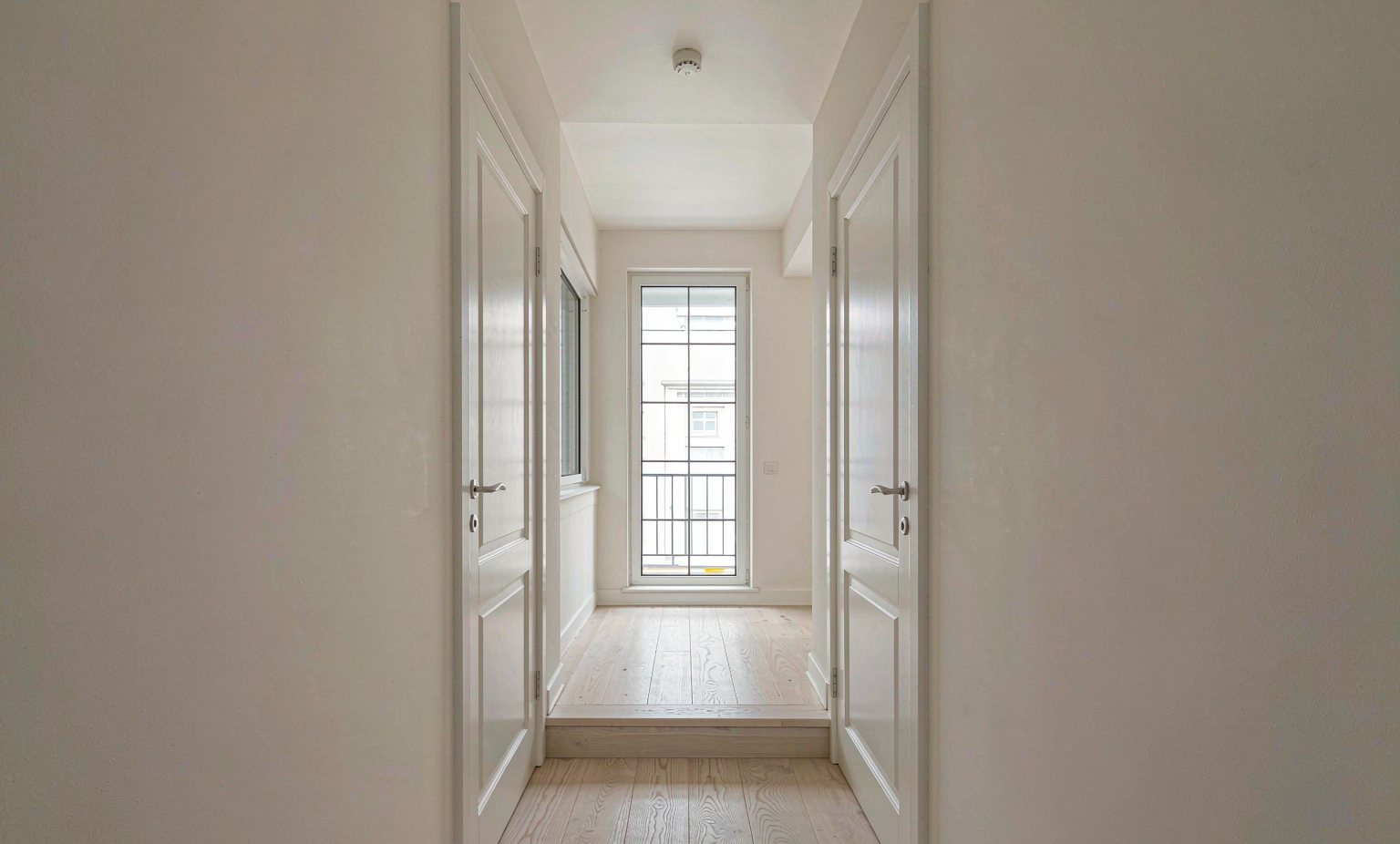
The minimum arrangement that actually works
- One alarm in every circulation space — hallway, landing, corridor — on every storey including the basement.
- One alarm inside every room where somebody sleeps. A closed bedroom door blocks both smoke and sound.
- Interlink them all, so a fire in the utility room wakes the whole household.
- Optical sensing in bedrooms, hallways and living rooms; a heat detector in the kitchen; CO detection wherever there is a boiler, stove or an integral garage.
- A head-of-stair position on the top floor, because a stairwell behaves like a chimney.
- A test date and a replacement date written on every device.
Houses, flats and bungalows
| Property | Typical arrangement | What people get wrong |
|---|---|---|
| Two-storey house | Hallway plus landing, one alarm per bedroom, heat in the kitchen, all interlinked | One alarm in the hall only, protecting an entire family and nothing else |
| Single-storey flat | Hall alarm plus one in each bedroom, interlinked | Assuming the hall is enough; smoke reaches a bedroom fastest when the door is open, but the sound does not when it is closed |
| Bungalow | Hall, each bedroom, living room; heat in the kitchen | Omitting the living room when it doubles as a bedroom or has an open fire |
| Maisonette / duplex | One alarm per storey minimum, plus bedroom protection | Forgetting that an internal stair acts as a flue between floors |
| Barn conversion / loft conversion | Add protection in the loft conversion and at the head of the stair | Ignoring long voids, exposed beams and unusual ceiling slopes |
| Mobile or static home | Alarms in each sleeping area, interlinked where possible | Hot and cold extremes plus compact layouts make sensing choice more critical |
A modern closed bedroom door can hold back smoke for several minutes — which is exactly what saves a life. It also attenuates an alarm by 20 to 30 dB. That single fact is the reason domestic codes increasingly require a device inside each sleeping room rather than relying on a hall alarm to do both jobs.
Rented housing, HMOs and the landlord's duty
The legal position differs by country but the pattern is consistent: the owner must provide certified alarms, keep them working, and be able to prove it. In most markets the practical specification has converged on sealed 10-year units in rented homes, precisely because a removable battery cannot be raided.
- Document everything. A dated undertaking, an inspection schedule and a test log protect both the tenant and the landlord.
- Use sealed 10-year units where the law allows a choice; they remove the most common cause of failure and the most common dispute.
- Check between tenancies, not only at the start. Replace anything past its date, and record it.
- Do not rely on a tenant to change a battery where the requirement is a sealed unit — that is precisely the requirement's purpose.
- HMOs and shared buildings usually need a higher category of protection, sometimes a Grade A system with a panel. Take professional advice for anything above a single household.
Sheltered housing and care homes
- Assume reduced mobility and reduced hearingEvacuation may depend on staff. Detection must be early, and warning must reach staff as well as residents — a local sounder alone is not a strategy.
- Add a monitoring layerCare environments generally need a panel-based system with zonal identification and remote signalling, not self-contained alarms.
- Plan for visual and vibrating warningWhere hearing is impaired, visual alarm devices and bed-shaker units are part of the design, not an optional extra.
- Expect more nuisance alarms, not fewerCooking, steam, aerosols, oxygen therapy equipment and dust all increase. Choose sensing carefully and plan for the alarm fatigue that follows repeated false alarms.
- Keep a rigorous logCare settings are inspected. A documented test, clean and replacement record is as much a part of compliance as the hardware.
What to do this weekend
- Count what you haveWalk the house and write down every alarm, its location and its age. Most households discover at least one expired unit.
- Test them allPress each test button and confirm a loud, clear sound. Test the interlink by triggering one unit and listening for the others.
- Check the bedroomsIf there is no alarm inside each sleeping room, that is the single most effective upgrade available to you.
- Get the kitchen rightHeat detection in the kitchen, smoke detection moved three metres clear of the hob.
- Write the datesInstallation year and replacement year on every device. Ten years from now somebody will thank you.
Work out how many you need
The coverage calculator takes floor area, storeys and bedrooms and returns a device count with the spacing rules it applied.