Smoke alarm or smoke detector?
The two words get used interchangeably in shops and almost never in a specification. Getting the terminology right changes what you order, what the electrician installs and what the fire officer accepts.
| Smoke alarm | Smoke detector | |
|---|---|---|
| Definition | A self-contained device containing a sensor, a decision circuit, a sounder and a power source | A sensing element that reports a signal to something else — usually a control panel |
| What it does on its own | Senses a fire and sounds 85 dB locally | Senses a fire and changes its output; it makes no sound at all |
| Typical standard | EN 14604, UL 217, GB 20517 | EN 54-7, UL 268, GB 4715 |
| Typical home | Detached house, flat, small HMO | Almost never, unless the building has a panel |
| Typical building | Any dwelling | Hotel, office, hospital, warehouse, data centre, shopping centre |
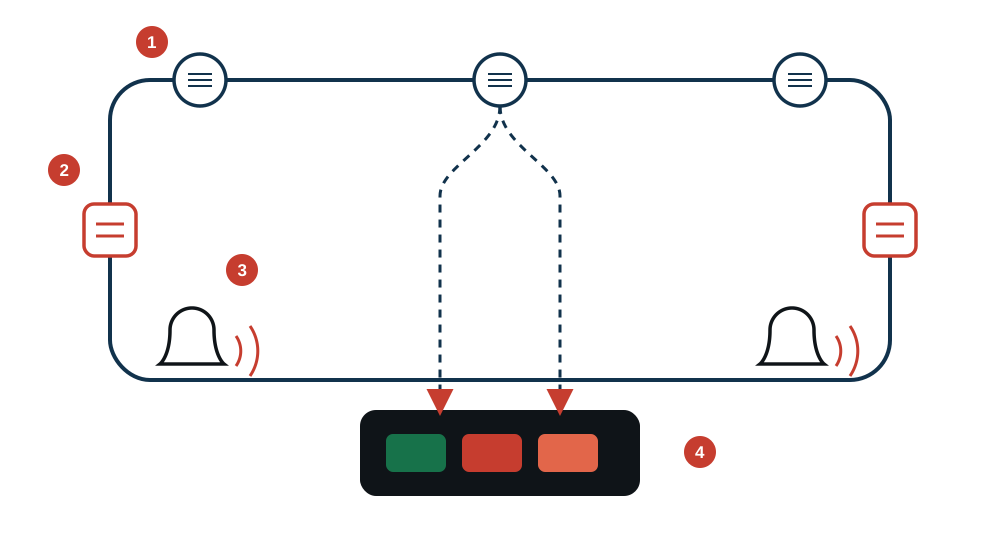
Why the distinction exists
A domestic alarm has to be cheap, self-installing and self-sufficient, so everything lives in one housing. A commercial system has to cover hundreds of points, tell the fire service which zone is in alarm, keep working when one device fails, release fire doors and shut down air handling. That requires central intelligence, monitored wiring and remote sounders — and once the intelligence is central, the sensing element no longer needs to make a noise.
The parts of a system, in plain terms
- Control and indicating equipment (the panel) — the brain. It monitors circuits, decides what constitutes an alarm, drives sounders and records events. Standardised by EN 54-2 or UL 864.
- Detectors — point smoke, point heat, multi-sensor, beam, aspirating. Standardised by EN 54-7, EN 54-5 and their equivalents.
- Manual call points — the break-glass or push-button boxes on escape routes, so a person can raise an alarm the detector has not seen yet.
- Sounders and sounder-beacons — audible and visual warning, standardised by EN 54-3, with beacons for noisy or accessible environments.
- Power supply and batteries — the standby system that keeps everything running when the mains fails.
- Interfaces and cause-and-effect — the modules that close fire doors, stop ventilation, recall lifts and notify a monitoring centre.
Conventional versus addressable
| Conventional | Addressable | |
|---|---|---|
| How it identifies a location | By circuit or zone — “something on zone 3” | By device — “device 27, third-floor east corridor” |
| Wiring | Radial or loop circuits with a zone per circuit | Loop with each device individually addressed; loop integrity often maintained through isolators |
| Best suited to | Small buildings and simple layouts | Hotels, hospitals, campuses and anything with more than a handful of zones |
| Diagnostic value | Limited — a fault narrows to a group | High — a fault points at one device, and dirty devices can be flagged before they fail |
If you are fitting alarms in a house, you are working with self-contained devices and none of the panel vocabulary applies. If your building has a fire panel, the devices you buy must be approved for that panel — a domestic alarm cannot be connected to it, and mixing brands or protocols on one loop is the most common cause of a system that will not commission.
Related terminology worth knowing
What is a “point detector”?
A detector that monitors the atmosphere at one location, as opposed to a beam detector that spans a space or an aspirating system that draws air to a remote sensor. Most ceiling devices in commercial buildings are point detectors.
What is a zonal or remote indicator?
A lamp mounted outside a locked room or above a door so that a responder can see which device has operated without entering. Common in hotels and apartment blocks.
What does “double-knock” mean?
A design in which two detectors must operate before the panel goes to full alarm — or in some panels, a smoke detector plus a heat detector. It reduces nuisance alarms but delays response, and is a design decision for a competent person, not a shortcut.
What is a VESDA or aspirating system?
An aspirating smoke detection system continuously draws air through a pipe network to a very sensitive laser scattering chamber. It detects a fire far earlier than point detection, which is why it protects data halls, clean rooms, museums and warehouses with high-value contents.
Buying for a home, or specifying for a building?
The residential and commercial application guides cover what changes between the two.