The rooms where smoke detection fails
Some rooms defeat smoke sensing for entirely predictable reasons: the air is full of particles that are not fire, or full of nothing at all. Specifying for these rooms is where most nuisance alarms are prevented before they happen.
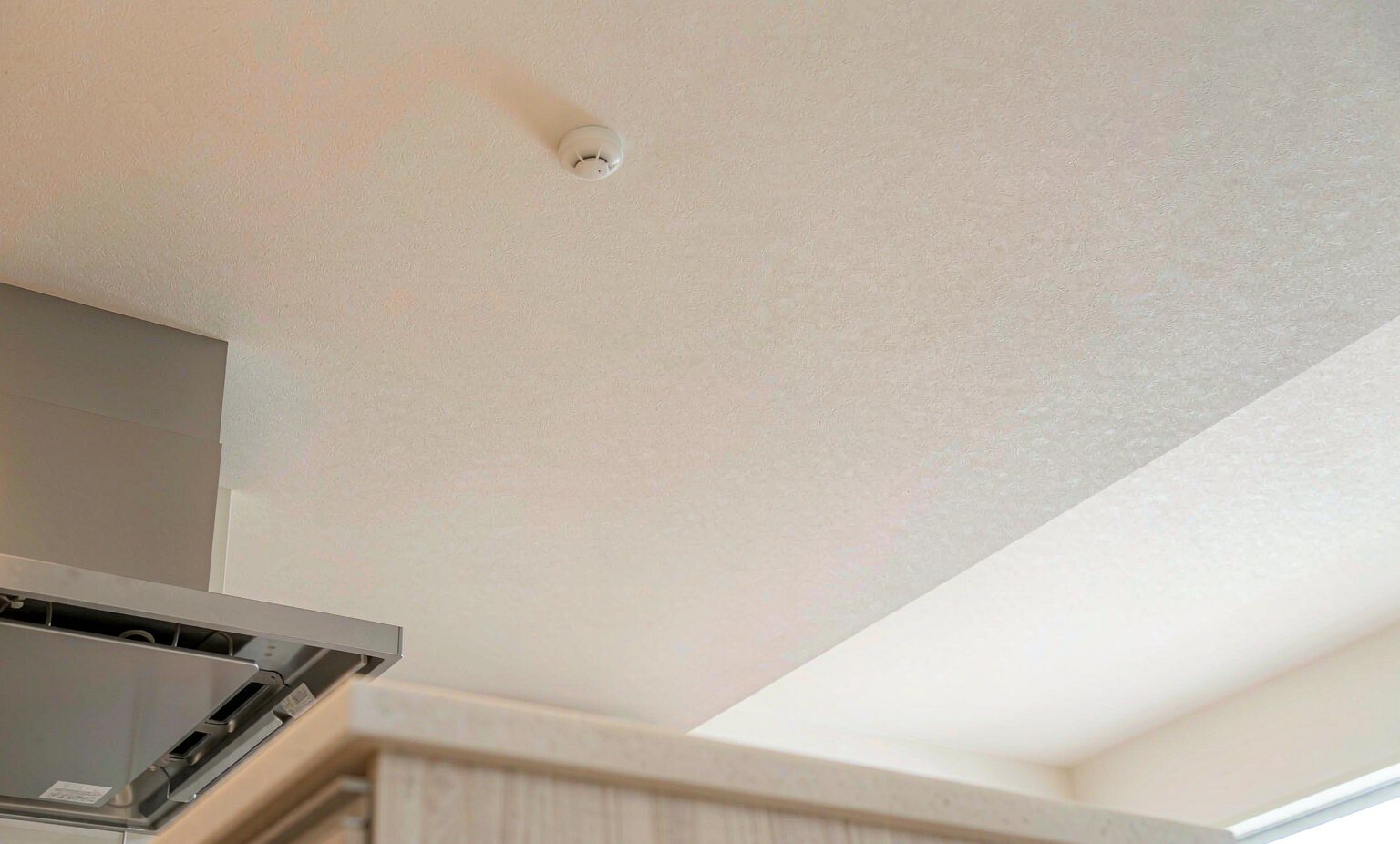
Room-by-room specification
| Room | Use | Avoid | Why |
|---|---|---|---|
| Kitchen | Heat detector (fixed temperature around 57–58 °C, or rate-of-rise) | Smoke detection within about 3 m of the hob or in the plume path | Cooking aerosol is indistinguishable from smoke to a scattering chamber |
| Bathroom / shower room | Nothing, or a heat detector if code requires | Any smoke detection inside the room | Steam behaves like smoke; a device beside the door will trigger on every shower |
| Laundry / utility | Heat detector, plus smoke detection outside the door | Smoke detection near a tumble dryer vent | Lint and steam in the exhaust stream |
| Garage (integral) | Heat detector; add CO detection where a vehicle or fuel is stored | Smoke detection where engines run or a car is parked | Exhaust soot and solvent vapour cause persistent nuisance alarms |
| Workshop / dusty store | Heat detection, or environment-rated detection with a cleaning regime | Standard optical chambers in a dusty atmosphere | Dust contaminates the chamber and holds the baseline signal high |
| Loft / attic | Heat detector, or an alarm rated for the environment | Standard alarms on the roof underside | Both temperature extremes: summer heat and winter condensation |
| Boiler room / plant room | Heat detection plus CO detection | Smoke detection where combustion air and flue gases are present | Combustion products, both smoke-like and gaseous |
| Stairwell / head of stair | Optical smoke detection at the top | Locations in the draughty path of the stairwell door | Smoke rises and the stair acts as a chimney — detection here buys escape time |
| Cold room / walk-in freezer | Heat detection and detectors rated for the temperature | Devices outside their rated range | Batteries and plastics fail in the cold; condensation forms on entry |
| Server / comms cupboard | Early-warning aspirating detection in critical installations | Cheap point detectors, or none at all | Concentrated value, cooling airflow dilution, and no occupants to notice smoke |
Heat detectors — the right tool, not a compromise
A heat detector is often described as a downgrade from a smoke alarm. In a kitchen it is not a downgrade: it is the device that will still be on the ceiling in two years' time, instead of being in a drawer because it cried wolf twice a week. Two mechanisms are used, usually together:
- Fixed temperature — triggers when the element reaches a defined threshold, commonly 57 °C or 58 °C for domestic and ordinary commercial use, with higher classes for hotter environments.
- Rate-of-rise — triggers when the temperature climbs faster than a defined rate, typically around 8 to 10 °C per minute, which catches a fast-growing fire before the fixed threshold is reached.
- Combined logic — most modern units require, or weight, both, so that a slow warm afternoon does not produce an alarm.
A heat detector protects property and interrupts a fast-growing fire. It does not detect the slow, smouldering fire that fills a room with lethal smoke while the temperature barely moves. Never remove smoke detection from bedrooms or escape routes in favour of heat detection.
Dust, moisture and temperature ratings
| Challenge | What to check in the specification |
|---|---|
| Dust | Chamber design and whether the manufacturer expects a cleaning interval; some designs use a labyrinth or a mesh screen to keep particles out |
| Moisture and spray | IP rating to IEC 60529 — do not accept “suitable for damp conditions” without a number |
| Heat | Maximum rated ambient temperature; in roof voids this is often the limiting factor |
| Cold | Minimum rated temperature and the battery chemistry at low temperature |
| Corrosive atmosphere | Whether the housing and terminals are rated for the environment; in some cases an enclosure is required |
| Flammable atmosphere | Whether the device is intrinsically safe or explosion-protected, and under what classification |
| Insects | Whether the chamber is insect-resistant, or requires periodic inspection |
If you must put a smoke alarm near a hostile source
- Move it, do not adjust itDistance is the only reliable fix. Three metres from a hob, out of the plume path, and away from doorways where steam escapes.
- Use the hush function for the incident, not as a strategySilencing is for the moment. Repeated silencing means the device is in the wrong place.
- Change the sensing technologyOptical in place of ionisation removes a large share of cooking nuisance alarms without losing much performance on domestic fires.
- Add rather than removeThe answer to a nuisance alarm in the kitchen is a heat detector in the kitchen and a smoke alarm outside it — not one device removed.
- Record what you changed and whyIn rented and commercial property this protects you at inspection time and helps the next person understand the design.
Not sure which of these rooms you have?
The product selector asks a handful of questions about the room and the building and returns a specification with the reasoning.